Friday, November 15, 2013

What Do You Do With a Tail Like This?

Back for round 2 of Informational Fridays.  This week I want to dispel the myth that all informational books are wordy, technical and difficult to read aloud.  Steve Jenkins is a very popular author of children's informational books.  His book What Do You Do With a Tail Like This? is a great example of informational books that can be used for primary children.


This book has a question and answer format.  On the first two page spread a question is posed and on the next two page spread the question is answered.  For example, on the page, "What do you do with a nose like this?" there are pictures of 5 different animal noses.  It is fun for kids to try to guess which animal the different noses belong to.  When you turn the page it shows each of the 5 animals in full with a fact about how that animal uses its nose, "If you're a hyena you find your next meal with your nose."

The book is perfect for younger children because of the short facts and their ability to interact with the text by guessing what animals the author might be getting ready to teach you about.  It also gives children many opportunities to connect with the book by sharing their own knowledge of any of the over 30 animals that are represented.  As an added bonus, if the child or class you are reading to has a particular interest in one of the animals you can turn to the back of the book to find out more information.

So I will leave you with one question for the weekend.

What do you do with a tooth like this?


Happy Reading!
Laura

Thursday, November 14, 2013

Throwback Thursday

It doesn't get more Throwback than our old pal Aesop.  I know most of you have heard of Aesop's fables but what do you really know about Aesop?  Before I share with you my book today I want to give you a few tidbits of information about Aesop so next time someone tells you one of his fables, you can say-

Did you know...
1) Aesop was a slave who lived in Ancient Greece.
2) His stories have been passed down through many forms of media including the written word, artwork and the most common, word of mouth.
3) Socrates passed his time in jail reciting Aesop's Fables.
4) There is now way to really tell is Aesop was a real person.
5) Many tales that had no literary source were credited to Aesop.

Now onto the book that I want to share with you.  Jerry Pinkney, a Caldecott illustrator of The Lion and The Mouse, has now illustrated a version of The Tortoise and The Hare.


 His version of the fable is mostly told in stunning pictures and he uses very few words.  I like that the words are few and far between so that young children can examine the picture and grasp meaning from them, essentially telling their own fable.  By looking at the picture you can see the difficult time that the tortoise is having and how easy the race is for the rabbit.  Just like in the original tale the rabbit stops (Pinkey has him stopping to gobble up lettuce before he takes his nap) and the turtle is able to pass him to win the race.

Pinkney cleverly chooses his words.  He slowly sprinkles the lesson of the fable onto the pages of the book.  He starts with the word slow and then every few pages adds another word until the phrase reads, "Slow and steady wins the race."  It is such a simple yet effective way to get the message across.

What is your favorite Aesop fable to share with others?

Happy Reading!
Laura

Wednesday, November 13, 2013

Manana

It is so easy to say, manana, I'll do it tomorrow.  I know we are all guilty of this!  In the book Manana Iguana by Ann Whitford Paul Iguana teaches his friends a lesson when they are always telling her they will help manana.


In the story Iguana and her friends Rabbit, Turtle and Snake, all decide to have a party to celebrate spring.  The party is going to be on Saturday.  Iguana immediately takes charge and starts getting ready for the party.  First she must make the invitations.  When she asks her friends for help they all give her an excuse of why they cannot help no and tell her they will help tomorrow.  Knowing that the invitations cannot wait, Iguana completes the task by herself.  The excuses continue all throughout the week.  Iguana ends up delivering the invitations, stuffing the pinata, cooking the food and hanging streamers all by herself.  When Saturday comes and Rabbit, Turtle and Snake show up to the fiesta to greet the guests Iguana finally speaks up angrily telling her friends that she did everything to prepare for the party so she will greet the guests without them.  Rabbit, Turtle and Snake feel very badly and sit in the corner while everyone else has a great time at the party.  When the party is over Iguana is too tired to clean up and says, "I'll do it manana."  Rabbit, Turtle and Snake decide to clean up the mess for Iguana and the next morning Iguana is happy with her friends again.  "Gracias!" Iguana says and offers her friends leftovers!

Not only does this book have a great story but it also sprinkles Spanish words throughout the books.  Instead of rabbit, the author uses conejo and instead of snake the author uses culebra.  Using the spanish is just another way to interest kids in the book.  Don't worry, if you are reading the book aloud there is a nice Glossary of Spanish words and pronunciations in the beginning of the book.

If you like this book be sure to check out more by Ann Whitford Paul like Fiesta Fiasco or Count on Culebra.  I am sure I will feature them on this blog one day!

In the mean time, don't put of until manana what you can do today!

Happy Reading!
Laura

Tuesday, November 12, 2013

Abbott & Costello

I know baseball season is over but I saw this book and thought it was too great not to share.  Abbott & Costello's "Who's on First?" is probably one of the greatest comedy skits of all time and now it has been made into a children's book.

 
The book is the exact script from the comedy skit but includes great illustrations and dialogue bubbles to help children follow along with the conversation.  Some of my favorite illustrations are the maps that show all the players and where they play.  Poor Costello is just not understanding the names of his other teammates and get more frustrated by the minute.  In the end Abbott brings out all the other players and Costello gets to see and meet them all.

A little history about Bud Abbott and Lou Costello.  The skit "Who's on First?" was introduced in the 1930's, roughly 80 years ago.  The duo simply called the famous skit, "Baseball".  Both Abbott and Costello are in the National Baseball Hall of Fame because of this comedy skit.  The skit has been acted out by a variety of different celebrities over the years but no one performs it quite like the creators.

So, if you child likes baseball, comedy or you just want to share with them a piece of history check out this book and before you do so check out Abbott and Costello in action.


Happy Reading!
Laura

Friday, November 8, 2013

Informational Fridays!

I started to realize that I have not posted any informational books (informational books are what we used to call "non-fiction").  I hate that I have totally ignored this genre for reading aloud because it is often the favorite of many children.

One reason we tend to not read aloud informational books is because they can be wordy and technical. It can also be very hard to find a "good" informational book to share with a child or children.  Before I share with you my informational pick of the week I want to offer you some tips for reading aloud informational books.

1) Pick a topic that interests the child.  Think animals, biographies, places or even how-to books.

2) Preview the text.  Before you sit down to read the book to a child or an entire class look at the book.
If it is wordy and technical pick out a few pages that are the most interesting and then leave the book setting out for the child to pick up and look through on their own.

3) Read only a section at a time. There is no hard and fast rule that when you read a book aloud you need to read the entire book.  Begin reading the informational book and when you can tell that interest is lost put it down only to pick it up and resume reading later.

4) Read the text features.  Informational books are known for their great pictures and text features (maps, diagrams, labels, charts etc.) If there are too many words on a page simply read and talk about the text features.  Sometimes that is the part that is the most interesting anyway!

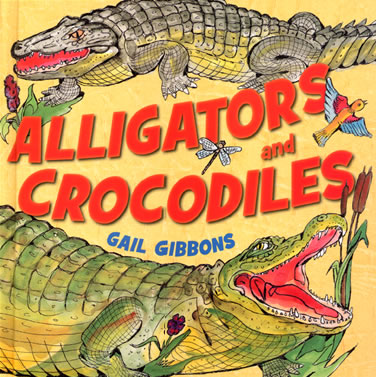
So, now onto my recommendation.  This week I chose a book by Gail Gibbons.  She is a very popular informational text author and has written over 100 book on a variety of topics.  The one I am sharing with you today is Alligators and Crocodiles.  


I chose (actually my son chose) this book because right now alligators are an obsession in our house.  When we arrived at the library he immediately wanted a book about alligators so after setting out a few choices this is the one he decided to bring home. 

At first I was worried because I thought that this book might be a little too much for him but it has the perfect combination of words and pictures to keep him interested and learning about alligators.  Of course since he is only one and a half he mostly likes looking at the pictures but there are some interesting facts in there for me!

The book covers everything from habitats, diets, body features, babies and even threats to the alligators and crocodiles.  Gail Gibbons uses a lot of labels on her pictures to give even more information about the animals.  It is a lengthy book (32 pages) so we have read it in several different sittings but if you were using it in a classroom you could definitely pick out the relevant pages to read aloud.  

So make sure to add some informational books to your daily read alouds!  I am sure your audience will love them!

What are some of your favorite informational books to read to children?

Happy Reading!
Laura

Thursday, November 7, 2013

Throwback Thursday

What better book to share on Throwback Thursday than The Velveteen Rabbit by Margery Williams, published in 1922.  I think most of us are familiar with the story of the much loved toy that becomes real.  It is such a touching story with a plot that came straight from a child's dream.


This is a particularly special book to me because it was used as the theme for my high school freshman retreat.  The book's theme of "Be Real" spoke volumes to teenage girls, starting out at a new high school just trying to fit in.  The story of the Velveteen Rabbit taught us that being the real you comes from having real love and real friendship.

At Mount St. Francis in 2013, sixteen years after becoming "Real" on Freshman Retreat!

Here are some great quotes from The Velveteen Rabbit:

“It doesn't happen all at once,' said the Skin Horse. 'You become. It takes a long time. That's why it doesn't happen often to people who break easily, or have sharp edges, or who have to be carefully kept. Generally, by the time you are Real, most of your hair has been loved off, and your eyes drop out and you get loose in the joints and very shabby. But these things don't matter at all, because once you are Real you can't be ugly, except to people who don't understand.” 

“Real isn't how you are made. It's a thing that happens to you. Sometimes it hurts, but when you are Real you don't mind being hurt. It doesn't happen all at once. You become. Once you are Real you can't be ugly, except to people who don't understand. Once you are Real you can't become unreal again. It lasts for always.” 

"The Rabbit sighed.  He thought it would be a long time before this magic called Real happened to him.  He longed to become Real, to know what it felt like; and yet the idea of growing shabby and losing his eyes and whiskers was rather sad.  He wished that he could become it without these uncomfortable things happening to him."

"'Give me my Bunny!'he said, "You mustn't say that.  He isn't a toy.  He's Real!' When the little Rabbit heard that, he was happy, for he knew that what the Skin Horse has said was true at last... He was real."

If your child loves Toy Story  read The Velveteen Rabbit.  It was making toys real long before Pixar!

Happy Reading!
Laura

Monday, November 4, 2013

A Good Read

My recommendation today is not a read aloud for children.  It is actually an article about some new research, that in my opinion, supports the case for reading aloud to children early and often.

The article, from Time Health and Family on October 29, states that some research shows children who live in poverty have smaller brains.  The reasons for this vary.  It could be from increased stress and anxiety due to living conditions or the lack of verbal interaction between children in poverty and their caregivers.

The article is a bit gloomy until the end.  Here is the last paragraph from the article:

"The good news, however, is that the effects may be reversible. Families don’t chose poverty, but changes in caregiving, especially during early childhood, could avoid some of the physical changes the scientists measured. “By studying socioeconomic status within a neuroscientific framework, we have the potential to expand our understanding of the biological signatures of poverty,” said Nina Kraus, professor of neurobiology, physiology and communication sciences at Northwestern University and an author of the second study, in a statement. “And a better understanding of how experiences shape the brain could inform educational efforts aimed at closing the socioeconomic achievement gap.”

To me this means that by reading to ALL children, beginning AS SOON AS POSSIBLE, we can reverse some of the effects poverty may have on children.  

To read the full article click here. 

Be sure to read to a child today!
Happy Reading!
Laura